They say we never stop learning, and indeed there is a new skill, lesson or moral to be picked up almost every day. Some are learned through school, others through experience, and quite a few through making mistakes we would rather not repeat.
Nonetheless, some skills are fundamental and are best developed before life begins demanding them from us.
For teenagers, this becomes particularly important as they approach college. School provides a considerable amount of structure. There are timetables, teachers, deadlines, parents asking whether an assignment has been completed and, sometimes, several reminders before something is finally done. College is a whole different story.
There will be more freedom over when to study, how to organise the day, how to spend money, which responsibilities to prioritise and what to do when something goes wrong. That freedom is part of growing up, but it also requires something that cannot simply be handed to a student at the college gate: the ability to manage themselves.
These are life skills for students, and they go far beyond what education alone can teach them.
The problem with always being managed
There is nothing inherently wrong with structure. In fact, young people need guidance, support and boundaries as they grow. The difficulty comes when structure does all the work.
A student may know that an assignment is due next Friday, but still wait until Thursday night to begin it. They may have a goal but no plan for reaching it. They may have several important tasks but no system for remembering them. They may even know what they should be doing and still struggle to make themselves do it.
This is more complex than laziness or irresponsibility. Sometimes these struggles indicate that a skill has not yet been practised enough.
The World Health Organization describes adolescence as an important period of cognitive and psychosocial development, when young people establish patterns of behaviour that can influence their health and wellbeing. It also identifies opportunities to develop life skills as part of the support adolescents need during this stage.
Learning to manage yourself can therefore not be about expecting a teenager to behave like a fully independent adult but rather gradually giving them the tools to become one.
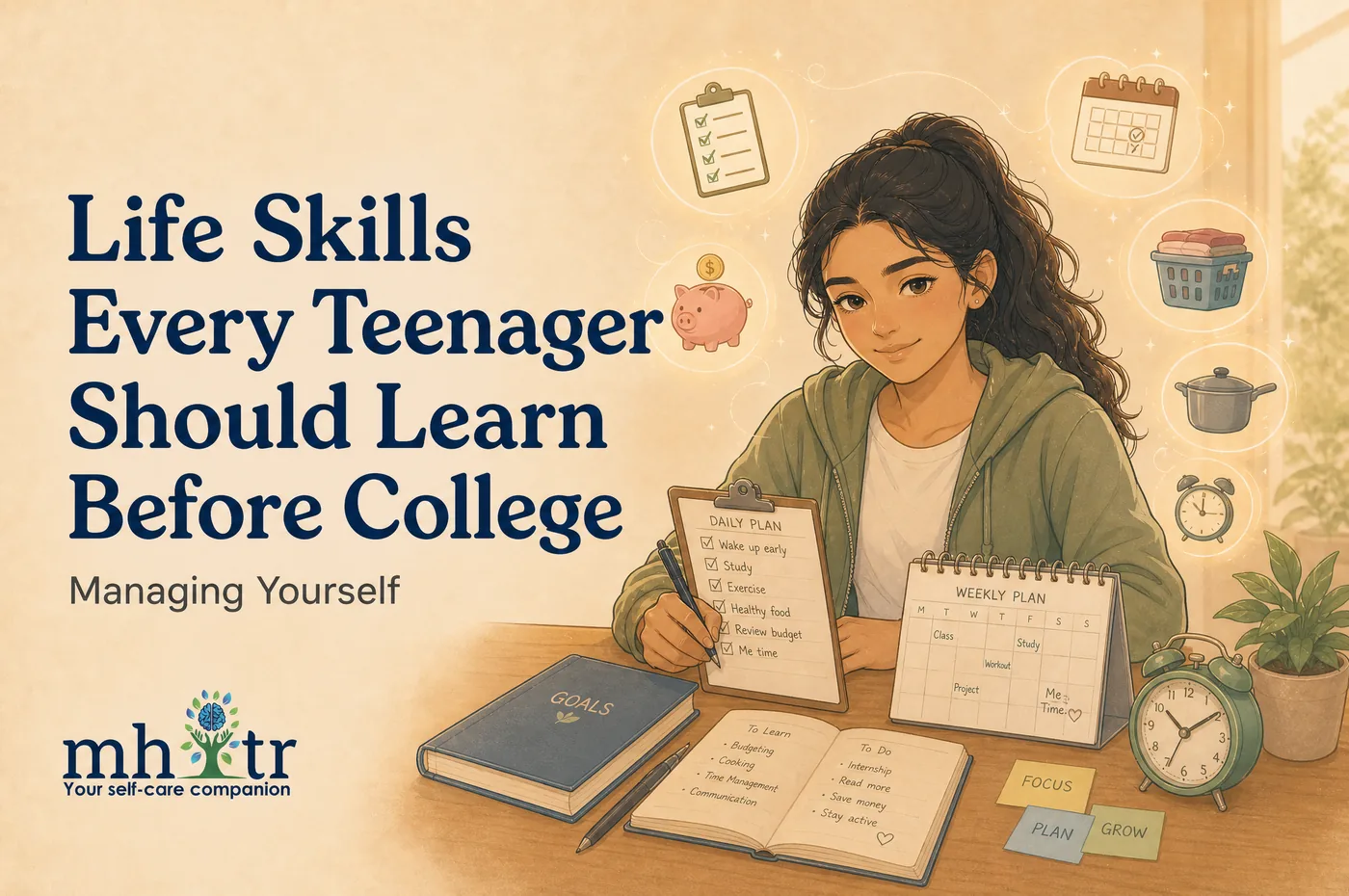
1. Planning and organising
Planning is pretty much a skill that sounds obvious until we notice how much of daily life depends on it.
A student who has three assignments, an examination approaching and an extracurricular activity on the same week needs more than the knowledge that all four things are important. They need to decide when each task will be done, what needs to happen first and how much time each task realistically requires.
But a plan is fundamentally useless if the person is not organised. This can be as simple as maintaining a calendar, arranging study materials, making a task list or dividing a large assignment into smaller steps. The point is to have as much efficiency as possible without living a confined, colour-coded lifestyle.
2. Goal setting
There is a philosophical difference between wanting something and actually working towards the desired goal. “I want to do better in mathematics” is an intention. Deciding what needs to improve, what action will be taken and when progress will be reviewed gives that intention some direction.
Goal setting teaches students to think beyond the immediate task and consider what they are working towards. It can apply to academics, hobbies, fitness, personal development or even something as simple as learning a new skill.
UNICEF’s adolescent life-skills resources include realistic goal setting and planning among competencies that can be developed through practice. The important part is that goals should be realistic enough to act upon. A goal that exists only as a distant ambition does not tell a student what to do today. That is why we need to plan towards the goal.
3. Keeping records
The point where most plans fail is keeping track of how much has been done and what else remains to be achieved. In a philosophical sense, how will you know when you have reached your goal/milestone if you don’t even know what it looks like?
Keeping records means having a reliable way of remembering what needs to be done, what has already been completed and what information may be needed later. For a student, that could mean recording assignment deadlines, keeping track of examination dates, noting important instructions or maintaining a simple record of personal commitments.
The point is not paperwork for its own sake, but rather it is realising that human memory cannot guarantee perfection, and so you must still move forward with your plan but with a guaranteed system. As responsibilities increase, having a system becomes increasingly useful. A notebook, calendar, planner or digital reminder can all serve the same basic purpose. The tool matters less than the habit.
4. Wise use of resources
Resources include but are not limited to money. Students work with limited amounts of time, energy, attention, information and perhaps financial resources. Learning to use them wisely is therefore part of becoming independent.
A teenager might have two hours available for studying but spend most of it switching between an assignment and social media. The problem is not necessarily a lack of time. It may be how that time is being used.
The same applies to money. Learning to distinguish between something that is wanted and something that is genuinely needed becomes abundantly clear once someone actually starts managing their own finances. Even information is a resource. Knowing where to find reliable information, when to ask for help and which sources deserve attention can prevent wasted effort.
5. Self-discipline
Planning tells us what we intend to do. Self-discipline helps us do it when we would rather be doing something else. And maybe that is by far one of the biggest challenges teenagers face, especially when there is nobody standing nearby to check whether the work has been completed.
Self-discipline does not mean forcing yourself to work constantly. It involves developing the ability to follow through on reasonable commitments, even when motivation fluctuates.
A student might decide to study for an hour before watching a film. On some days, that will be easy. On others, the film will suddenly appear to be the most important cinematic event in human history. The skill here is learning to make the decision based on the commitment rather than the mood of the moment.
6. Self-responsibility
As teenagers become more independent, responsibility gradually moves from the adults around them towards the young person themselves. Self-responsibility means recognising your role in your own decisions, actions and commitments.
It does not mean blaming yourself for everything that goes wrong. Circumstances matter, and sometimes problems genuinely are outside our control. However, it does mean being able to say:
“This happened. What part of it was within my control, and what can I do now?”
That question can be much more productive than searching for someone else to blame. It also changes how mistakes are handled. A missed deadline is either an opportunity for an excuse, or it can become information about what needs to change next time.
7. Self-awareness
Perhaps none of these skills can work as well without self-awareness. A student needs to understand their own habits, strengths, limitations and tendencies.
- Do they concentrate better in the morning or evening?
- Do they regularly underestimate how long assignments will take?
- Do they avoid difficult tasks until the last minute?
- Do they take on too many commitments?
- Do they work better with written reminders?
Self-awareness makes those patterns visible. It also allows a teenager to recognise when they need help. Being independent does not mean doing everything alone. Sometimes managing yourself means knowing when another person needs to become part of the solution.
So how are these skills actually learned?
The simple answer is: through action. Life skills are not particularly useful when they remain definitions in a notebook.
UNICEF’s approach to adolescent life-skills education emphasises participation, real-life experience, practice and reflection rather than relying solely on lectures. UNICEF India similarly describes participation, cooperation, practice through real-life experiences, safe learning environments and targeted instruction as useful principles for developing life skills.
That means a teenager can practise these abilities through ordinary responsibilities.
Parents can allow them to plan part of a family activity, manage a small budget, organise their own study schedule or keep track of an important commitment.
Schools can give students responsibilities through projects, clubs, events and other activities where planning and organisation have actual consequences. Schools stand as the more important practice grounds since it is the closest thing to a college. It mimics the diversity and complexity of a college ecosystem well.
Even a simple weekly exercise can help: What do I need to accomplish this week? What resources do I have? What might get in the way? What will I do if my original plan does not work? The exercise is small, but the underlying habit proves to be valuable.
A note for parents
Parents understandably want to make life easier for their children. Sometimes, however, helping a teenager is resisting the urge to solve every manageable problem for them.
If a student forgets something, the immediate response may be to remind them. If they repeatedly forget it, a more useful question might be: “What system could help you remember this yourself?” That small change moves the conversation from dependence towards responsibility.
The same applies to planning. Parents can provide guidance without taking over every decision. They can ask teenagers what they think should happen next, what their plan is and what they might do differently if the plan fails. This should not be mistaken for withdrawing support.
After all, a parent cannot follow their child into every classroom, workplace, relationship or decision they will encounter later in life. Eventually, the student has to become the master.
Preparing for what comes next
College and university are often described as major turning points in life, and part of that comes from the freedom they introduce. But freedom without preparation can quickly turn to anarchy.
Knowing how to plan, organise, set goals, keep track of responsibilities, use resources wisely, practise self-discipline, take responsibility and understand oneself will not guarantee academic success. It will not prevent every missed deadline, poor decision or difficult week either.
What these skills can provide is a foundation. They help a teenager move from being managed towards learning how to manage themselves. And that is an important transition in its own right.
Because before a young person can confidently manage a timetable, a university workload, a career or the many responsibilities of adult life, they first have to learn something much closer to home: how to manage themselves.
References
- United Nations Children’s Fund. (2025). Guide: Adolescents and life skills education. UNICEF
- United Nations Children’s Fund India. (n.d.). Life skills. UNICEF India
- World Health Organization. (n.d.). Adolescent health. WHO
- World Health Organization. (n.d.). Adolescence: Developing life skills. WHO
- MHITR®. (n.d.). Igniting Minds: Socio-emotional learning program for students